Star Wars Eclipse “Literally Cannot Be Finished” Without More Staff, Striking Quantic Dream Developers Warn
The Strike That Reached Lucasfilm The timing was no coincidence. According to striking developers speaking to journalists, the walkout was scheduled for the very day Lucasfilm Games was due to review...


The Strike That Reached Lucasfilm
The timing was no coincidence. According to striking developers speaking to journalists, the walkout was scheduled for the very day Lucasfilm Games was due to review Star Wars Eclipse’s progress. Workers wanted the licensor to see, in real time, what they believe is the project’s critical vulnerability.
Developers identified as Théo and Jules told reporters that the Eclipse team is already understaffed. The planned redundancy plan (PSE) would eliminate 115 positions from the defunct Spellcasters Chronicles team – but those developers argue that the Eclipse team needs those 115 people, not the other way around. As Théo put it, “We need everyone. The game literally cannot be finished if those colleagues are let go.”
The affected employees have already been inactive for roughly a month as of the strike, representing what the union STJV calls “a whole month of lost production.” The strike itself is not an isolated event. It forms part of STJV’s national “Summer Grève Fest” strike call, which has drawn solidarity from developers at Ubisoft, Gameloft, and Don’t Nod. A broader industry-wide demonstration began at Quantic Dream’s gates before spreading across French studios.
How a Live-Service Failure Derailed Eclipse
The crisis stems from a failed pivot. Quantic Dream, seeking additional revenue to fund the long-gestating Star Wars Eclipse, developed Spellcasters Chronicles, a 3v3 hero shooter and MOBA hybrid. The game launched in early access on February 26, 2026. It peaked at just 888 concurrent players on Steam. By May 2026, less than three months after launch, the title was shut down.
Management responded by proposing the elimination of 115 jobs – the entire team behind the failed live-service project. But workers argue the logic is backwards. They say the skills developed on Spellcasters Chronicles are transferable to Star Wars Eclipse, and that the Eclipse team is already stretched thin. Cutting the workforce, they maintain, would not solve the studio’s problems; it would collapse the project.
The union STJV has also raised legal concerns. Under French labor law, a company cannot target a specific team for redundancy based on the failure of a single project. Redundancies must be determined by a company-wide point system that considers seniority, family situation, and other objective criteria. The STJV argues the proposed plan is potentially illegal.
“Top-Down Culture” and Blocked Communication
Workers describe a studio culture that has long been problematic. Striking employees speak of a “top-down” environment where management discards work without explanation and issues contradictory instructions. These complaints echo earlier allegations from 2018, when Quantic Dream faced accusations of a toxic workplace in reports from French media.
Perhaps most tellingly, developers say they have explicitly asked for direct talks with parent company NetEase, which acquired Quantic Dream in early 2023 for approximately €100 million. But according to the workers, Quantic Dream’s management has blocked those discussions. The striking developers are adamant that the layoff plan is being driven by Quantic Dream’s leadership, not by NetEase – though rumors persist that NetEase may be looking to divest. Bloomberg reported in 2025 that NetEase CEO William Ding considers games that cannot generate “hundreds of millions of dollars annually” not worth developing.
The question of who ultimately holds the reins matters. If NetEase is merely allowing management to proceed, the strike’s target may need to shift. But for now, workers are clear: their dispute is with Quantic Dream’s management, and they want the parent company to step in.

Star Wars Eclipse: A Project in Peril
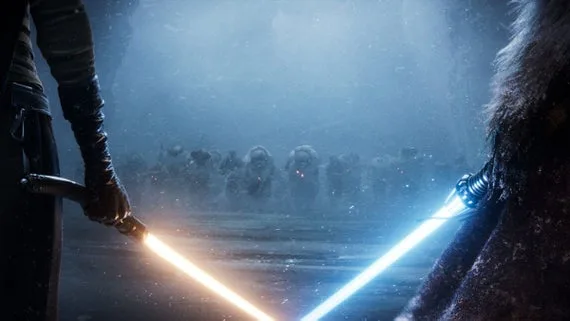
Announced at The Game Awards in December 2021, Star Wars Eclipse was positioned as a major narrative-driven action game set in the High Republic era – a period of the Star Wars timeline largely unexplored in video games. The cinematic trailer, showing a galaxy in transition and the promise of Quantic Dream’s signature branching storytelling, generated enormous hype. But development has been described as “very slow going” and in “development hell” for some time, with Insider Gaming reporting earlier that NetEase had considered divesting from the studio. Now, with the live-service pivot having failed and a quarter of the workforce threatened with layoffs, the project’s future is more uncertain than ever.
Striking developers insist that if the layoffs proceed, Star Wars Eclipse cannot be completed. The game is already understaffed; losing 115 skilled developers would be a death blow. The Lucasfilm delegation’s visit on the day of the strike may force an intervention. If Lucasfilm decides the risk is too high, it could pull the license or demand NetEase intervene directly. No official statement has been made by any party, but the clock is ticking.
The Future of Star Wars Eclipse Hangs in the Balance
The Quantic Dream strike is not merely a labor dispute about jobs. It is a referendum on the studio’s ability to deliver the marquee project it promised to the world. A failed live-service game, a management style described as top-down and opaque, and a parent company rumored to be losing patience have combined to create a perfect storm.
With a national industry strike rallying behind the cause, the outcome will resonate far beyond Paris. This is a case study in how corporate restructuring, misaligned project strategy, and worker mobilization can collide to imperil a triple-A game. The picket line sent a message. Now the question is whether Lucasfilm will amplify it.