Yoshi and the Mysterious Book: A Cozy, Pacifist Platformer Redefines the Franchise for Switch 2
Editor's Note: This article discusses a speculative game concept for illustrative purposes, analyzing its potential design and market positioning. In an era where blockbuster games often equate...


Editor's Note: This article discusses a speculative game concept for illustrative purposes, analyzing its potential design and market positioning.
In an era where blockbuster games often equate spectacle with success—demanding lightning-fast reflexes, punishing difficulty, and cinematic bombast—a quiet revolution has been blooming. The "cozy game" genre, championed by titles like Animal Crossing and Stardew Valley, has proven there's a massive audience for experiences built on comfort, creativity, and charm over conflict. A compelling concept for the Nintendo Switch 2, tentatively titled Yoshi and the Mysterious Book, illustrates how Nintendo could deliver its most deliberate entry into this space yet. This vision for a 2D platformer isn't just another colorful adventure; it's a radical reinvention where the beloved dinosaur cannot die. Set against a hypothetical launch window crowded with high-profile ports, such a game would feel like a statement of intent—designed not to challenge your thumbs, but to delight your heart.
The Pacifist Platformer: Gameplay Without Peril
This concept is built on a foundation of pure comfort. The traditional stakes of the platformer genre are completely removed. There are no lives, no game over screens, and Yoshi cannot take damage. This isn't a game about survival or conquest; it's a game about curiosity and gentle discovery. The design philosophy shifts the focus entirely from combat and precision to exploration, environmental puzzle-solving, and interacting with a vibrant world.
Yoshi retains his classic moveset—the flutter jump, tongue grapple, and egg-throwing are all present—but they are reimagined as tools for interaction, not aggression. The pivotal new ability in this design is the "Tail Flip." This move allows Yoshi to carry friendly creatures on his back, temporarily gaining their unique traits to solve puzzles. For instance, one creature might allow Yoshi to blow bubbles that form temporary platforms, while another could change how he interacts with certain objects. This ability transforms the environment into a series of charming logic puzzles rather than obstacle courses.
Progression follows a similarly relaxed loop. The concept proposes collecting stars by completing simple quests and helping the world's inhabitants. These stars would be used to unlock new chapters. A hint system, activated by spending collectible tokens, ensures players are never truly stuck. The ultimate goal is to learn facts about the world's creatures, with each discovery directly unlocking new stages. It’s a gameplay loop that rewards observation and kindness, representing a significant and refreshing potential departure for the franchise.
A Living Storybook: Art, Audio, and Structure
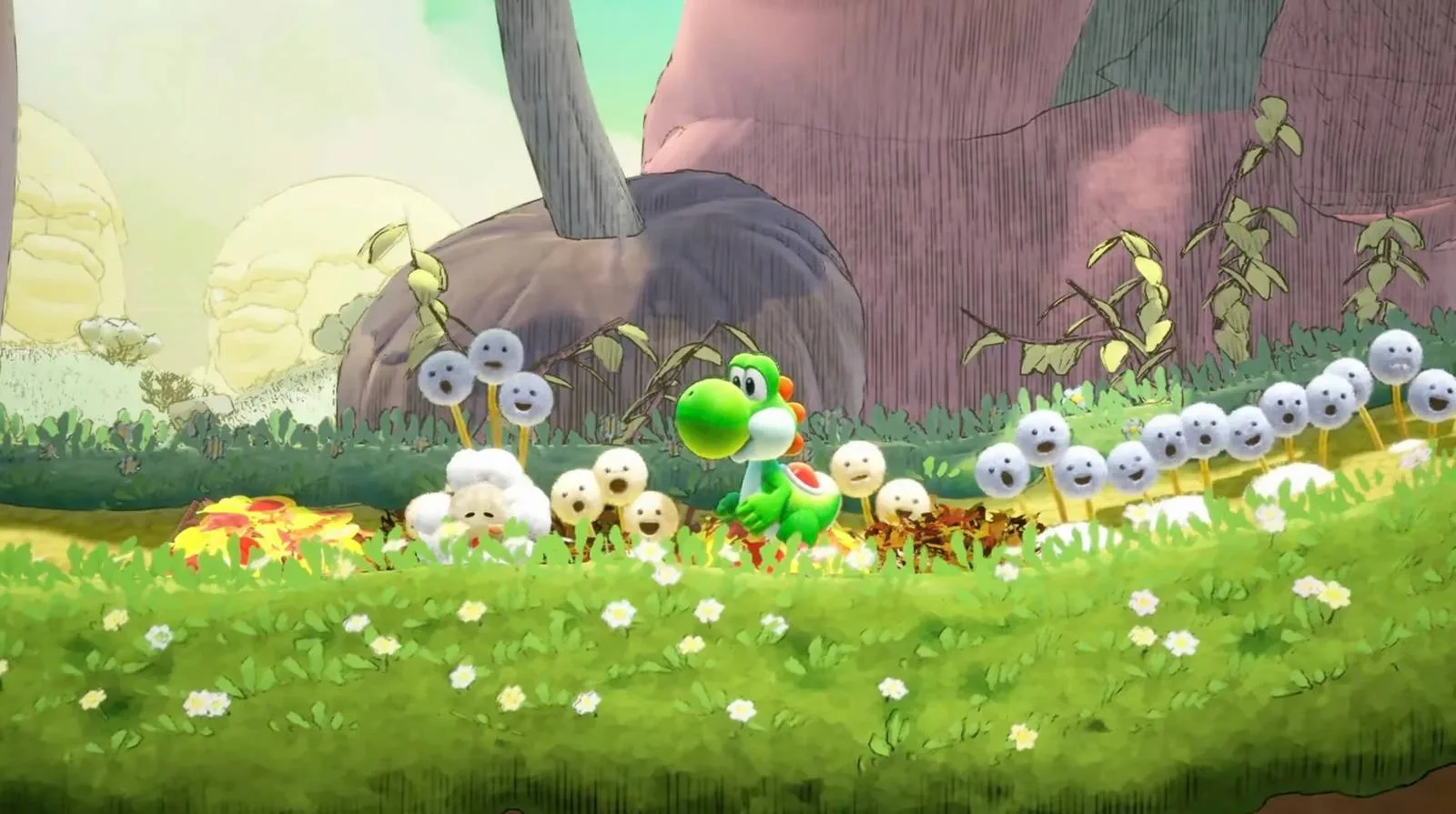
Visually, this concept marks a significant aesthetic shift for the series, abandoning the yarn and cardboard textures of Woolly World and Crafted World for a lush, hand-drawn, cell-shaded storybook aesthetic. Every frame could look like a beautifully illustrated page from a children's fairy tale. This style would be accentuated by a deliberate, subtle "hitch" in the animation, creating a unique stop-motion or flipbook feel that brings the narrative framing to life in every movement.
That narrative centers on helping Mr. E (Mr. Encyclopedia), a sentient, talking book who has lost the contents of his pages. The game’s structure is a direct extension of this premise. The world map is literally a storybook page. Players would use a magnifying glass to select which new creature to meet next, with each choice opening a new "chapter" or level. This meta-narrative reaches its most charming conclusion when you successfully befriend a creature: the game would prompt you to name your discovery, and that name is permanently recorded in your book. You’re not just playing a story; you’re actively writing it alongside Yoshi and Mr. E.
The audio design complements this perfectly, featuring a gentle, delightful soundtrack. This vision includes musical mini-games set to familiar tunes like "Twinkle, Twinkle, Little Star," performed by new creatures like the musical Croakaokes. It’s a holistic sensory experience crafted to evoke warmth and wonder.
A Potential 2026 Switch 2 Exclusive in a Packed Lineup
This singular artistic vision gives Yoshi and the Mysterious Book a distinct identity that Nintendo could leverage, positioning it deliberately within a competitive hypothetical launch window. For the sake of analysis, if such a game were scheduled for release on May 21, 2026, with a pricing model of $70 for physical and $60 for digital editions, its position would be fascinating. It would arrive in a crowded month that could include narrative adventures, major ports, and quirky platformers.
This context highlights a potential Nintendo strategy. While other platforms and publishers might lean on mature ports and known quantities, Nintendo could use its new hardware to launch a bold, first-party exclusive that could only come from its studios. Yoshi and the Mysterious Book wouldn't be leveraging the Switch 2's rumored power for 4K textures or intense physics; it would be using it to deliver a singular, stylized, and artistically confident experience. In a month of varied releases, it would stand alone as a must-play family-friendly exclusive, offering a distinct value proposition compared to ports of games already available elsewhere.
The Bigger Picture: Yoshi's Role and Nintendo's Rumored Future
This concept does more than redefine a single franchise; it recontextualizes Yoshi’s potential role within Nintendo's portfolio. Historically a supporting character or the star of bright but traditional platformers, Yoshi could become a vessel for Nintendo’s most experimental and accessible gameplay ideas. Yoshi and the Mysterious Book follows in the footsteps of Yoshi's Island and its focus on baby-protection, but pushes the "pacifist platformer" concept to its logical, cozy conclusion.
This creative risk-taking may signal a broader trend for Nintendo. Persistent industry rumors suggest a given year might not see a new 3D Mario game, leaving space for other franchises to shine. Speculation is often rife about potential reboots or sequels for series like Star Fox and Captain Toad. In this landscape, a game like Yoshi and the Mysterious Book could represent a new direction for what some consider Nintendo’s "B-tier" franchises. The focus isn't on competing with the graphical fidelity of cross-platform giants, but on doubling down on unique charm, inventive mechanics, and pure, undiluted Nintendo magic. It’s a philosophy that turns perceived limitations into creative strengths.
By redefining challenge as curiosity and leveraging its hardware for artistic style over sheer power, Yoshi and the Mysterious Book (as conceptualized here) embodies a compelling path forward for Nintendo. It proves that next-generation appeal isn't solely defined by horsepower but by the power of imagination and artistic vision. By trading peril for peace and challenge for charm, it carves out a unique space as the quintessential "Nintendo" experience for the next generation. For fans of cozy games, creative design, and the simple joy of discovery, this may not be the loudest game of 2026, but it has all the ingredients to be the most memorable—a potential sleeper hit that wins with a smile instead of a shout.
Tags: Nintendo Switch 2, Yoshi and the Mysterious Book, Cozy Games, Platformer, Nintendo Exclusive, Game Design Analysis