The Nintendo Direct at 15: A Beloved Format Nearing Its End?
Fifteen years ago this October, Satoru Iwata sat before a camera and fundamentally changed how Nintendo communicated with the world. The Nintendo Direct—a polished, globally synchronized...

Fifteen years ago this October, Satoru Iwata sat before a camera and fundamentally changed how Nintendo communicated with the world. The Nintendo Direct—a polished, globally synchronized broadcast—replaced the chaos of E3 press conferences and the uncertainty of fan-translated blog posts with something revolutionary: direct, unfiltered access to the company's vision. But as the Switch 2 enters its second year and a new general Direct is expected any day, a quiet question is echoing through the industry: How much longer will this format last?
The Birth of a Revolution – How Iwata Changed Nintendo's Communication
When the first Nintendo Direct aired in October 2011, it represented a radical departure from tradition. Satoru Iwata, then president of Nintendo, had grown frustrated with the limitations of E3—a competitive, rushed environment that often forced developers to show incomplete games. Reports from the time indicate Iwata was inspired by Apple's meticulously orchestrated event-style announcements, where the company controlled every aspect of the narrative.
The format was an instant success. By eliminating reliance on third-party blogs and fan translations, Nintendo could deliver its message simultaneously to audiences across the globe. The Direct quickly established a reliable cadence: February, June, and September became sacred dates on the gaming calendar. Fans knew exactly when to expect major reveals, and the anticipation became part of the experience.
Cracks in the Foundation – Why Former Employees Say It's Not the Solution
Despite its iconic status, internal doubts have long simmered beneath the surface. Former Nintendo employees Kit Ellis and Krysta Yang recently revealed on their podcast that a meeting held a year before they left the company concluded with a startling statement: "Nintendo Direct is not the solution." The company was urged to proactively think of alternatives.
Ellis elaborated on the challenge, noting that Directs were deliberately aimed only at the most dedicated fans. "Attempts to make them more mainstream were vetoed due to logistical complexity," he explained. Yang added a more sobering perspective, stating that Nintendo "will just cut the cord on stuff"—a pattern the company has demonstrated with beloved hardware and software before. The implication is clear: no matter how iconic the format, Nintendo is not afraid to abandon it.
These internal doubts are already manifesting in observable changes to the format. Recent Directs have increasingly focused on single-game showcases—Kirby Air Riders, Donkey Kong Bananza, Tomodachi Life: Living the Dream—rather than the broad multi-title presentations that defined the format's golden age. Meanwhile, major announcements like The Legend of Zelda movie release date have appeared not in a Direct, but via the Nintendo Today app, a platform designed to drip-feed information to hardcore fans.
This fragmentation raises fundamental questions: Are general Directs being quietly phased out in favor of targeted, app-based updates? Or is this simply a reflection of the Switch 2's launch year, where focus naturally narrows to specific titles? The answer may determine the format's survival.
Fan Perspectives – The Love-Hate Relationship with the Format
The gaming community is divided. User firebush03 argues that Nintendo should stick with its current strategy, noting that Directs cater to a vocal audience while slower information drips via the Nintendo Today app allow games to succeed through word-of-mouth. "Directs are for the loudest fans," they wrote. "The app lets quieter titles breathe."
Others defend the Direct format passionately. User Veknoid_Outcast cites the excitement of anticipation, unexpected reveals, and community discussion as irreplaceable. "Pre-launch marketing and word-of-mouth are not mutually exclusive," they argued. "The Direct creates the moment that generates the word-of-mouth."
Critics, however, point to the format's excesses. User trunkswd noted that 1-2 hour Directs with 50+ games become forgettable, suggesting fewer titles—20 or fewer—with longer trailers of 4-5 minutes each would be more effective. The tension between spectacle and substance has never been more apparent.

What's at Stake for the Industry
The potential demise of the Nintendo Direct would reverberate beyond Nintendo's fanbase. For indie developers, Direct appearances have historically provided a powerful launchpad, offering exposure to millions of viewers in a single broadcast. Without this platform, smaller studios may find it harder to break through the noise of an increasingly crowded market. The shared community experience—the live chats, the reaction videos, the collective gasps at surprise reveals—would also fade, replaced by the solitary consumption of app-based updates or influencer-driven marketing. While the industry has weathered such transitions before, the loss of a unifying event could fundamentally alter how gaming culture builds anticipation and fosters community.
The April 2026 Direct – A Test of the Format's Future
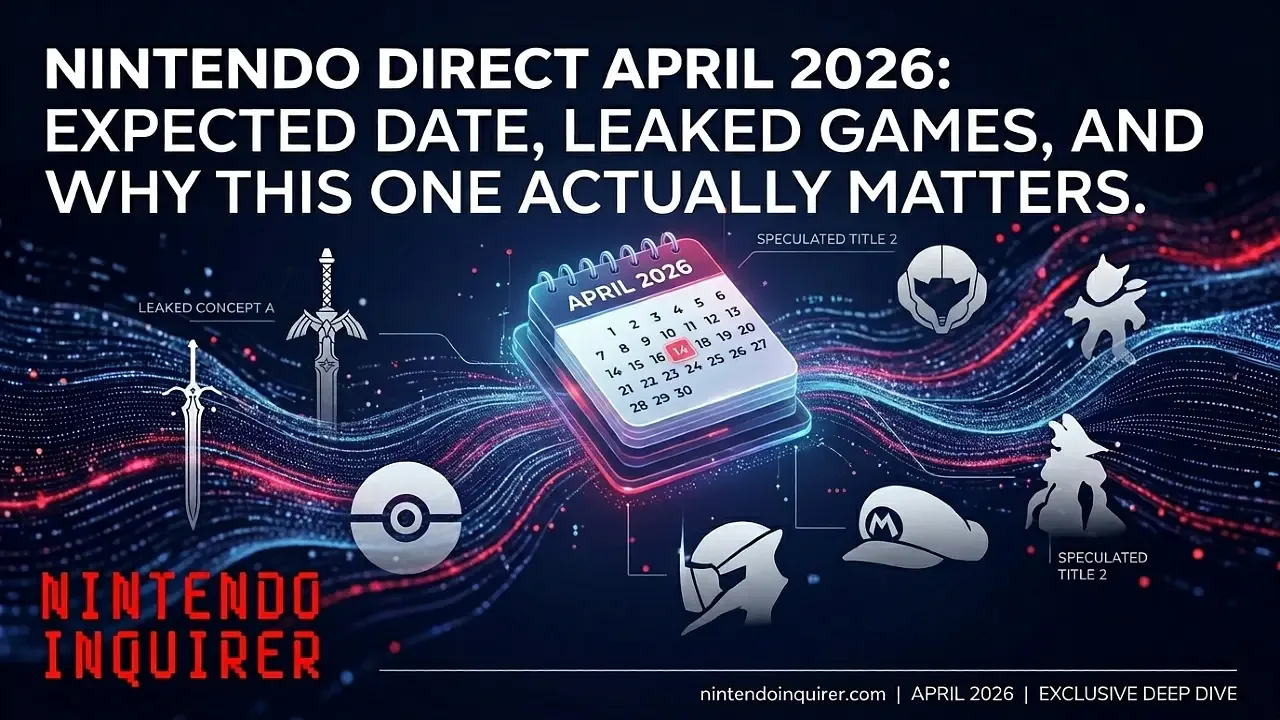
As of mid-April 2026, a general Direct is expected imminently, most likely during the week of April 20–24. The timing is dictated by historical patterns, recent PEGI ratings for Splatoon Raiders (PEGI 7, third-person action) and Fire Emblem: Fortune's Weave (PEGI 12, tactical RPG), and credible rumors about a Star Fox title and an Ocarina of Time remake.
The leak of these major titles—and Nintendo's reported frustration—adds significant pressure. Kit Ellis described the company as "absolutely furious" about the scale of the leak. If the biggest reveals are already known, does the Direct still feel special? The presentation is expected to run 40-45 minutes, a noticeably shorter length that may reflect the company testing a more focused format—potentially a bridge between the old Direct model and whatever comes next.
What is almost certain to appear: release date trailers for Splatoon Raiders and Fire Emblem: Fortune's Wrath, a final pre-launch trailer for Yoshi and the Mysterious Book (releasing May 21), and a launch trailer for Mouse: PI for Hire (releasing April 16). What is not expected: a new 3D Mario game (credible sources point to 2027), a Switch 2 price drop, or Mario Kart World DLC. The shorter runtime and leak-dampened excitement will test whether the format can still captivate an audience that already knows the headlines.
The Nintendo Direct has been a cornerstone of gaming communication for 15 years—a span equal to the time between the Nintendo 64's North American launch and the Direct's premiere. But the tension between spectacle and intimacy, between leaks and surprise, and between hardcore fans and the mainstream suggests its reign may be ending. The upcoming April 2026 Direct, shorter, more focused, and potentially leak-tainted, could serve as a litmus test for whether the format still has value. Just as Iwata's Direct replaced the chaotic E3 press conference, a new format—perhaps more intimate, more app-driven, or entirely unexpected—may soon replace the Direct. The question isn't whether Nintendo will change, but whether fans will follow.