Star Citizen's VR Odyssey: From Kickstarter Promise to Experimental Reality
A Promise Forged in the Kickstarter Era The story begins in 2012, in the electrifying early days of both Star Citizen’s record-breaking Kickstarter and the modern VR renaissance. Amidst stretch goals...

A Promise Forged in the Kickstarter Era
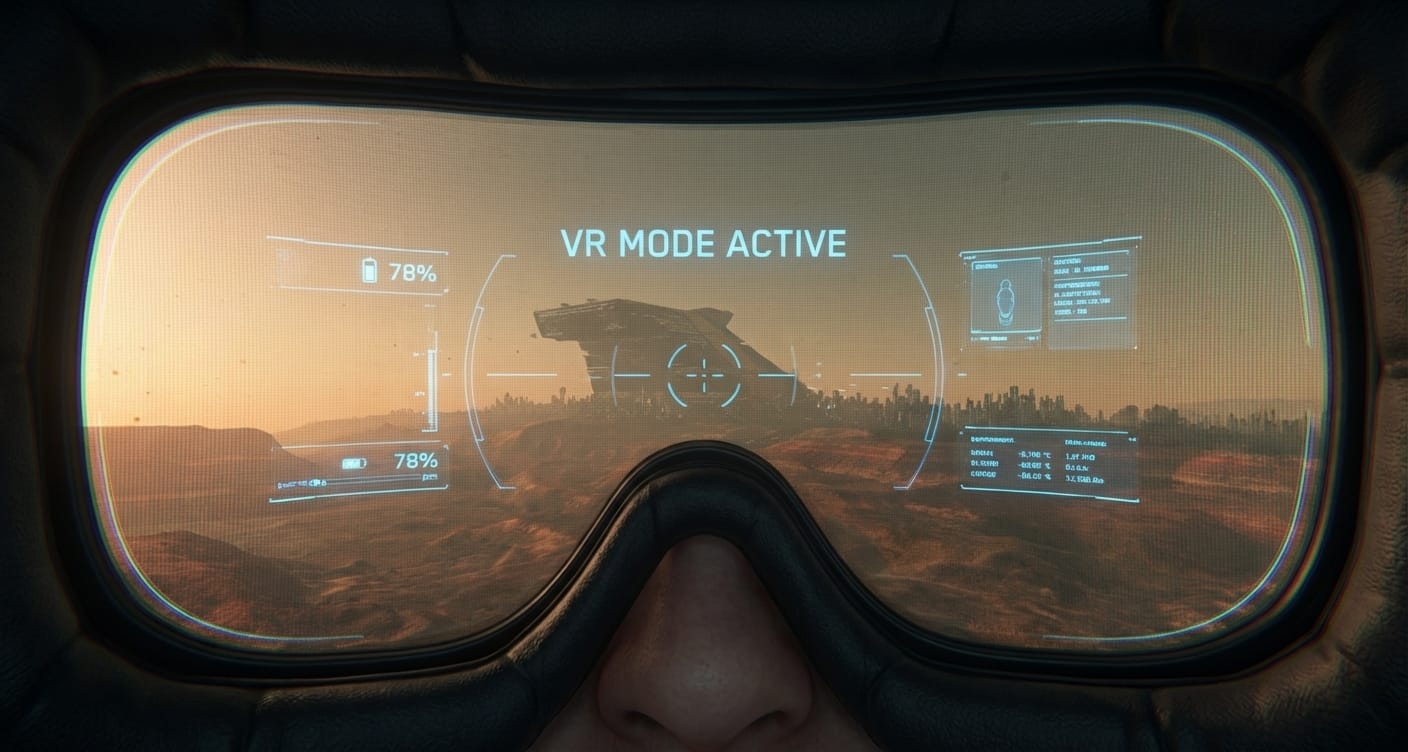
The story begins in 2012, in the electrifying early days of both Star Citizen’s record-breaking Kickstarter and the modern VR renaissance. Amidst stretch goals for new ships and star systems, a specific, tantalizing target was set: $12 million for Oculus Rift support in the hangar module. This wasn't a vague notion; it was a concrete pledge to early backers that their digital spacecraft would be experiences they could step inside. The goal was smashed, and for a brief moment, the promise was kept.
In 2014, backers could don an early Oculus Rift DK2 and look around their personal garage of spaceships. However, this implementation was a fleeting glimpse. As Star Citizen’s scope exploded from a single-player spiritual successor to a massively multiplayer universe with procedural planets, seamless planetary flight, and hyper-detailed ship interiors, that early VR code was left behind. It was shelved in the years following as foundational systems were rewritten from the ground up.
Yet, the vision never died. Chris Roberts and Cloud Imperium Games (CIG) leadership have repeatedly reconfirmed VR as a long-term goal. From mentions of ongoing R&D in 2015 to a direct recommitment at CitizenCon 2024, the message has been consistent: VR is coming.
The Mountain of Technical Challenges
Why has it taken so long? The answer lies in the very DNA of Star Citizen. Implementing true, comfortable VR isn’t as simple as enabling a stereo 3D view. It requires a fundamental re-engineering of how the game renders its world.
The primary technical hurdle is “dual render”—the necessity to render the entire scene twice, once for each eye, to create proper stereoscopic depth. For a game as visually dense and system-intensive as Star Citizen, this effectively doubles the graphical workload. More critically, it conflicts with the game’s “unified first-person” animation system, where your character’s body and view are intricately linked for seamless transitions between walking, flying, and interacting. Decoupling the player’s head movement from their in-game body for natural VR locomotion within this system is a monumental task.
CIG engineers have been clear: VR cannot be a priority until the foundation is solid. Engine Programmer Silvan Hau and others have stated that the completion of the Gen12 renderer and the shift to the Vulkan API are non-negotiable prerequisites. These core engine overhauls are needed for better performance and modern graphics features, which in turn create the necessary headroom and technical framework for VR to even be feasible. With Vulkan work finally approaching completion, Silvan-CIG has recently been able to begin integrating and testing VR-related functionality directly into the engine.
Given these hurdles, CIG has discussed a “phased implementation.” A potential “Phase 1” could be a limited but impactful experience: using VR to sit in your cockpit during flight or to walk around your ship in the safety of a hangar, marveling at the scale. This is a world apart from the monumental engineering required for a full, room-scale, interactive VR experience like Half-Life: Alyx across an entire persistent universe. The former is a challenging milestone; the latter is a second game built atop the first.
Signs of Life: Evidence and Community Ingenuity
For years, these daunting technical hurdles made VR seem like a distant theoretical concern. However, recent developments suggest CIG's foundational work may finally be reaching a point where experimentation can begin in earnest.
In July 2025, tangible signs emerged. Senior Director Sean Tracy announced that planned internal testing for VR was slated to begin “in the next month or two.” This was the first official timeline the community had heard in years. The evidence became even more concrete in November, when data miners discovered OpenXR files—the industry-standard VR/AR API—in a Star Citizen tech preview build. More recently, players uncovered the openxr.dll file directly within game folders, further confirming that CIG is actively wiring VR support into the engine.
Even more shocking was what surfaced shortly after: early experimental VR support is already partially accessible in the PTU build. Though not announced publicly, the community found that VR can be enabled through a set of console commands and a simple configuration tweak. While extremely early and unfinished, this represents the first hands-on VR functionality in Star Citizen in more than a decade.
Current Experimental VR Activation (Community-Discovered)
- 1. Create a user.cfg file and add the line sys.OpenXR = 42 in the PTU folder.
- 2. Enable and enter the game using a VR headset (tested with Virtual Desktop).
- 3. Launch the game and open the console in the main menu.
- 4. Enter
r_StereoMode 1- 5. Bind a hotkey for head-tracking recenter in the control settings.
Players testing this early mode report surprisingly functional results: flight is fully usable, FPS gameplay mostly works but feels rough, F-interaction behaves better than expected, markers are not yet eye-synced, but HUD and mobiGlas map displays function.
While CIG works internally, the player community has never been content to wait. For years, a dedicated subset of pilots has taken matters into their own hands using third-party software like VorpX or OpenXR toolkits to force Star Citizen into a VR view. Communities like the VRse Discord server have become hubs for sharing profiles, tweaks, and workarounds.
These methods are a testament to fan passion, but they also highlight the gap between a hack and a native implementation. Community VR can deliver the breathtaking “wow” moment of sitting in a cockpit in true stereoscopic 3D, offering a powerful glimpse at the potential. However, it often struggles with interface issues, motion sickness from un-optimized locomotion, and a lack of proper VR interaction. It proves the dream is compelling, but also why the official path is so necessary—and so difficult.
The Road Ahead: Realistic Expectations and Development Realities
So, when will we see official VR? The critical context is CIG’s official stance: VR is not the current development priority. The focus remains squarely on completing core technology (like Vulkan), delivering the single-player campaign Squadron 42, and expanding the core systems of the Persistent Universe. VR exists in the future roadmap, but it sits in a lengthy development queue.
Based on developer comments, a realistic “Phase 1” of official VR might launch as a limited, opt-in beta. It could allow players to experience ship interiors and cockpit gameplay in VR, potentially with simplified interactions. This would be a massive win and a proof of concept, but it would be just the beginning. The journey from that point to a fully realized VR universe where you can manually load cargo, interact with every panel, and explore cities is a marathon, not a sprint.
The timeline is inherently vague. Even after the Vulkan/Gen12 work is declared complete, VR must compete with dozens of other planned features for developer attention. It will be a slow, iterative process, likely measured in years rather than months for a full implementation.
Star Citizen’s VR odyssey is a perfect microcosm of the project itself: a vision of breathtaking scope, pursued through a gauntlet of technical and logistical challenges, and sustained by a community that holds fast to the original dream. The recent experimental steps—the internal tests, the OpenXR files, the appearance of openxr.dll in the game build, and the hidden VR console commands—are like seeing a distant star finally begin to brighten through a telescope. A full, seamless VR universe remains a destination on the far horizon, but after over a decade of waiting, the community can finally see that the path is being charted. The promise, against all odds, is very much alive.