Silent Hill: Townfall Gets September 2026 Release Date - Scotland, First-Person Horror, and the Next Chapter of Konami’s Revival
Silent Hill has left America. For the first time in franchise history, the fog now rolls into a Scottish fishing village called St. Amelia, and players will see it through a first-person lens. That...

Silent Hill has left America. For the first time in franchise history, the fog now rolls into a Scottish fishing village called St. Amelia, and players will see it through a first-person lens. That revelation came during Sony’s June 2 State of Play, where Konami and Annapurna Interactive finally unlocked the details around Silent Hill: Townfall, announcing a concrete release date of September 24, 2026. This is the most experimental entry in Konami’s three-year revival, and here is everything we know.
The Announcement, Release Date, Platforms, and Editions
The new trailer confirmed that Silent Hill: Townfall will launch on September 24, 2026, for PlayStation 5 and PC via Steam and the Epic Games Store. No Xbox or Nintendo Switch version has been announced.
Pre-orders are live for two editions. The Standard Edition costs $49.99, while the Deluxe Edition is priced at $59.99 and includes 72-hour early access, exclusive CRTV skins, a digital artbook, and the full soundtrack. For players who want to dive into St. Amelia’s fog as early as possible, the Deluxe Edition offers a three-day head start. September has become a recurring launch window for the revived franchise, Silent Hill 2 (2024) and Silent Hill f (2025) both released in that month, and Townfall now solidifies that tradition.
This release marks Konami’s third consecutive year of Silent Hill games, capping the slate originally announced in October 2022 alongside the film Return to Silent Hill. After Silent Hill 2 reached 6 million players and Silent Hill f shipped over 2 million copies, the publisher appears confident in continuing the momentum with a bold new direction.
A New Setting, From Silent Hill to St. Amelia
For the first time in a mainline-adjacent Silent Hill title, the story does not take place in the United States. Townfall is set in 1996 in the fictional Scottish coastal village of St. Amelia, a place based on the real-life St. Monans in Fife. The fog, the isolation, the salt-stained buildings, all are built from the same atmospheric cloth as the original series, yet transplanted to a fresh cultural context.
Developer Screen Burn Interactive (formerly No Code), a Glasgow-based studio, chose Scotland deliberately. According to the PlayStation Blog, the team considered northern Europe but ultimately drew on personal experience. The result is a setting that feels both authentically local and eerily Silent Hill, a small fishing village where the sea mist rolls in thick and the past refuses to stay buried.
The shift away from the titular American town raises questions. Will the Otherworld manifest differently in Scottish folklore? Early trailers show industrial rust, abandoned fish-processing plants, and a decrepit lighthouse, imagery consistent with the franchise’s signature Otherworld. But the local mythology hinted at in concept art (sea creatures, kelpie-like silhouettes) suggests the supernatural rules may incorporate Scottish myths such as the each-uisge, a violent water horse. The fog remains, but the architecture and cultural texture are unmistakably different.
First-Person Horror and Gameplay Innovations
Silent Hill: Townfall is played entirely from a first-person perspective, a franchise first. While previous entries occasionally used first-person segments (notably in Silent Hill 4: The Room’s apartment sequences), no full game has ever adopted this viewpoint. It is a dramatic change that forces players to confront the horror head-on, without the protective distance of an over-the-shoulder camera.
The core gameplay mechanic revolves around a CRTV handheld device. This battered television set functions as both a detection tool and a survival lifeline. By tuning the CRTV’s static, players can reveal the presence of nearby enemies, peek around corners or through walls, and even glimpse the Otherworld’s hidden geometry. The PlayStation Blog explains that combat is optional, evasion is often the better strategy. This design choice encourages tension over action, forcing players to weigh risk and reward rather than simply shooting everything that moves.
The PS5 version makes full use of the DualSense controller. Adaptive triggers adjust resistance when tuning the CRTV, haptic feedback simulates the device’s electrical hum, and motion controls allow for precise static adjustments. These features aim to make the act of using the CRTV feel tactile and anxiety-inducing.
Puzzles are narrative-driven, designed alongside the story to carry deeper meaning. Screen Burn Interactive has a pedigree for this approach, their previous games, Stories Untold and Observation, wove puzzles into storytelling rather than treating them as arbitrary obstacles. Expect riddles that reveal character backstory and environmental clues that unfold the mystery of St. Amelia.
Story and Characters, Simon Ordell and the Nurse Zoe
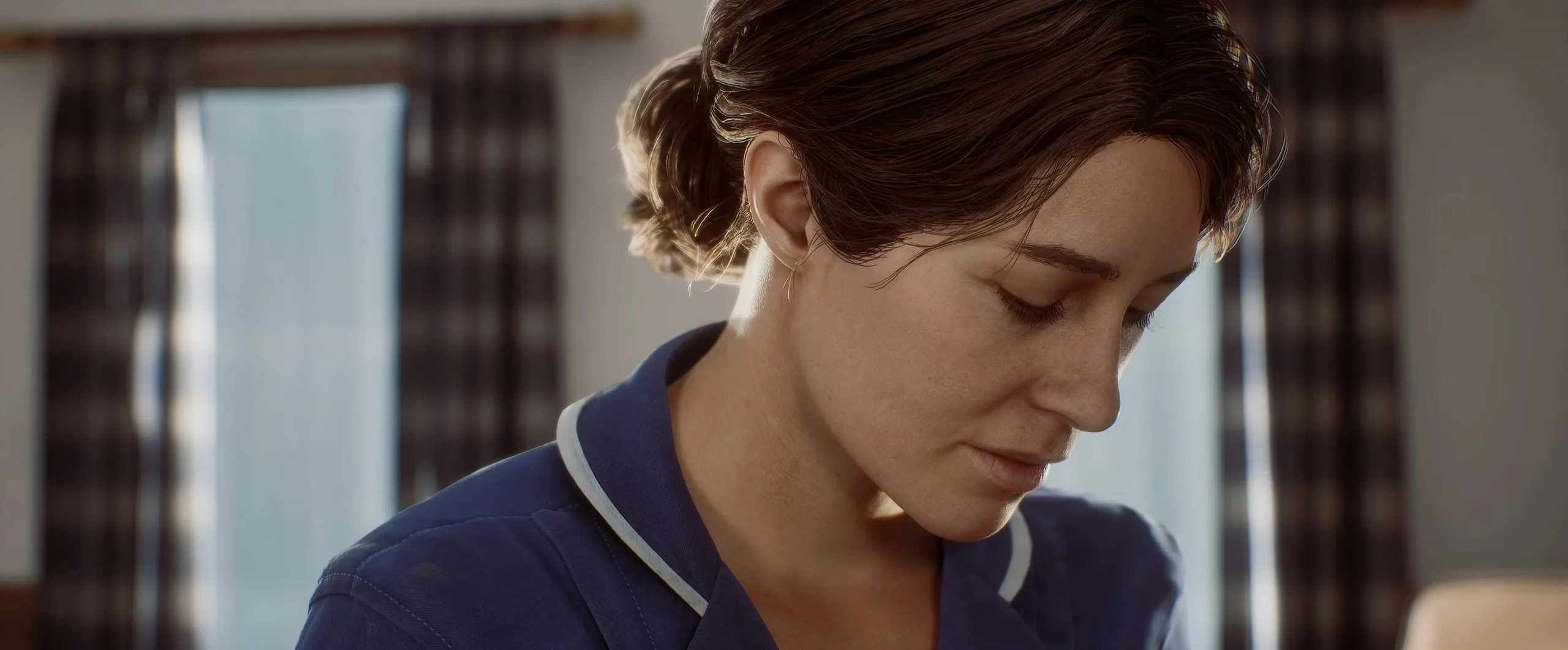
The protagonist is Simon Ordell, a man called back to the island of St. Amelia to “put things right.” What exactly brought him there, and what debt he owes, remains shrouded in the same fog that blankets the town. Through the CRTV, Simon receives communications from a new character named Zoe, a nurse from the local family clinic. Her connection to Simon and her role in the story are deliberately vague, but early trailers suggest she may be tied to his return, perhaps as a guide, perhaps as a harbinger.
The game is directed and written by Jon McKellan, a veteran of narrative-driven horror. The soundtrack comes from Pilotpriest, whose previous work includes atmospheric scores for Everybody’s Gone to the Rapture and Virginia. Built on Unreal Engine 5, Townfall promises photorealistic lighting and dense environmental detail, the grainy CRTV, the peeling wallpaper, the rain-slicked cobblestones.
Screen Burn Interactive (formerly No Code) is an award-winning Glasgow studio known for tight, unsettling experiences. Stories Untold reimagined text adventure horror through a retro lens, and Observation placed players inside an AI aboard a derelict space station. Their approach to Silent Hill is likely to emphasize psychological dread over jump scares, using isolation and uncertainty as primary weapons.
The Studio and the Revival Context
Silent Hill: Townfall was first teased in October 2022 with a cryptic cinematic that showed only a room and a static-filled TV. It took over three years to see a full reveal, which finally came in the February 2026 State of Play, followed by the release date confirmation in June. An insider reported in early 2025 that the game became “far more ambitious” than its original plans, explaining the extended development.
The commercial success of Konami’s revival cannot be overstated. Silent Hill 2 (2024) reached 6 million players, while Silent Hill f (2025) shipped over 2 million copies. Both titles earned critical acclaim and reinvigorated a franchise that had been dormant for over a decade. Townfall now carries the weight of expectation: it must honor the legacy while innovating enough to justify its existence. Moving the setting to Scotland, adopting first-person, and introducing a CRTV-based evasion system are bold bets, but Screen Burn Interactive has proven it can deliver narrative horror that resonates.
The Fog Ahead
Silent Hill: Townfall is shaping up to be the left-field gem of Konami’s revival, a small, passionate team transplanting the franchise’s core horror to a fresh setting while experimenting with first-person gameplay and a unique CRTV-based mechanic. With its September 24 release date locked in, fans can look forward to a deeply atmospheric, narrative-driven experience that honors the series’ legacy while forging its own fog-laden path. Whether it can match the commercial success of its predecessors remains to be seen, but for now, the wait for St. Amelia is about to begin.