High on Life 2 Review: A Chaotic, Creative Sequel That Skates Past Its Flaws
High on Life 2 arrives under a microscope. As Squanch Games' first major release since Justin Roiland's departure, this $60 Unreal Engine 5 sequel must prove its chaotic, comedic FPS formula can...

High on Life 2 arrives under a microscope. As Squanch Games' first major release since Justin Roiland's departure, this $60 Unreal Engine 5 sequel must prove its chaotic, comedic FPS formula can evolve. The central question: does its brilliant creativity and sharper narrative justify the technical chaos and divisive gameplay?
A New Tone and a Sharper Story
Gone is the first game's layer of cynical, nihilistic humor often attributed to Roiland's influence. In its place, High on Life 2 presents a surprisingly more structured, and arguably "nicer," satirical core. You reprise your role as the bounty hunter, now navigating life as a B-list celebrity in the wake of your previous exploits. This fame frames a new mission: a systematic takedown of the executives at Rhea Pharmaceuticals, a blatant and often hilarious satire of "Big Pharma." The shift from fighting a generic alien cartel to a more pointed, terrestrial-corporate evil gives the narrative a clearer, more compelling throughline.
The most significant evolution, however, lies in its storytelling mechanics. For the first time in the series, your choices carry tangible weight. The narrative features meaningful branching paths that directly influence the story's conclusion, a marked departure from the largely linear adventure of the original. This addition of player agency transforms the experience from a passive comedy routine into an interactive story where your decisions as the celebrity hunter feel consequential, adding welcome depth and replayability to the 10-12 hour campaign.
Gameplay Evolution: Skateboards, Sentient Guns, and Sloppy Chaos
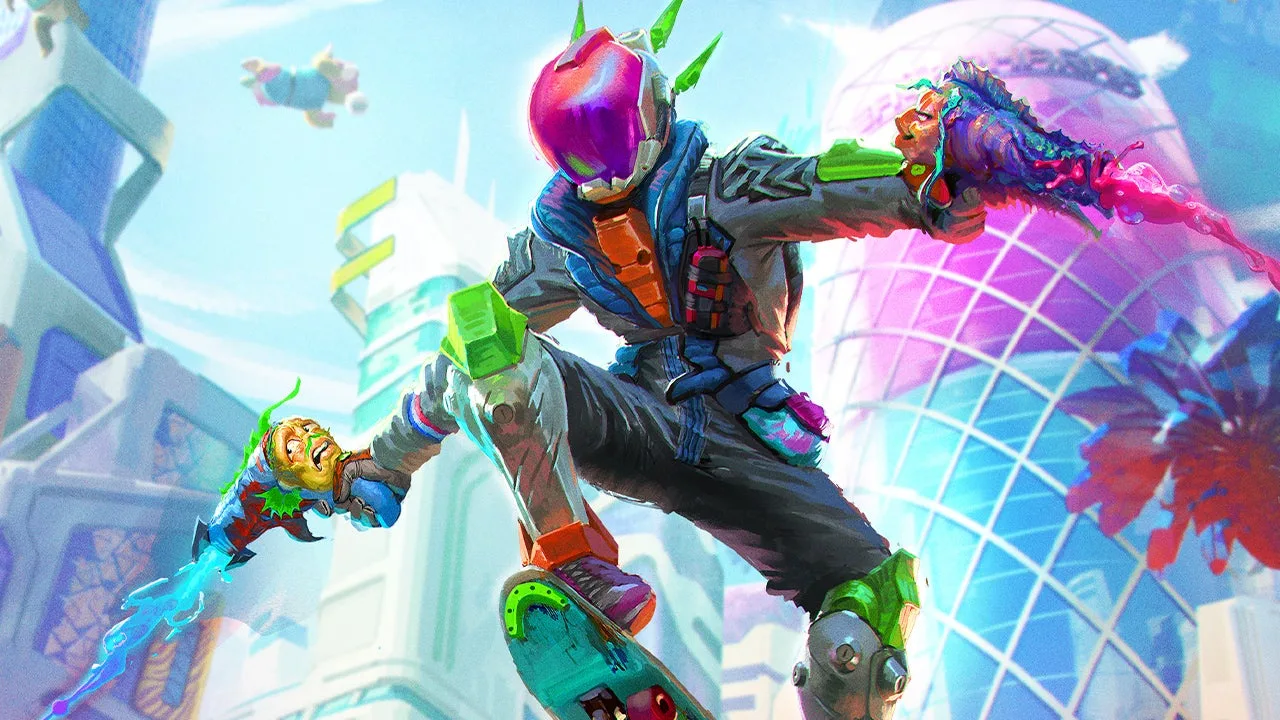
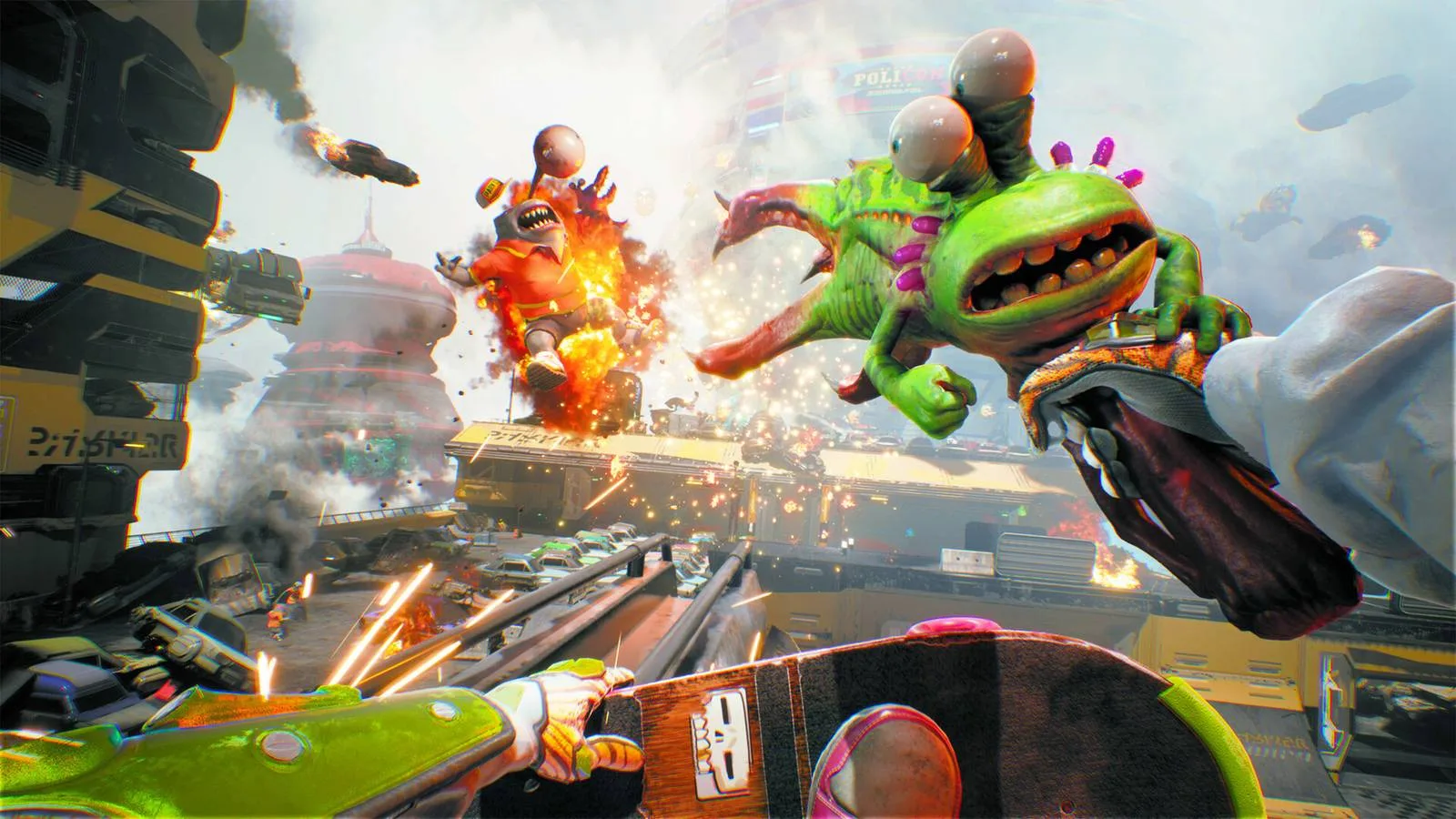
The headline addition to your arsenal isn't a gun—it's a skateboard. This transformative tool redefines traversal, allowing for fluid grinding on rails, boosting across gaps, and performing trick jumps. It’s also woven into combat, letting you ram into enemies at high speed. While a novel idea, the skateboard proves divisive; it can exacerbate the game's inherent chaos, making platforming sections feel imprecise and combat encounters even more visually noisy.
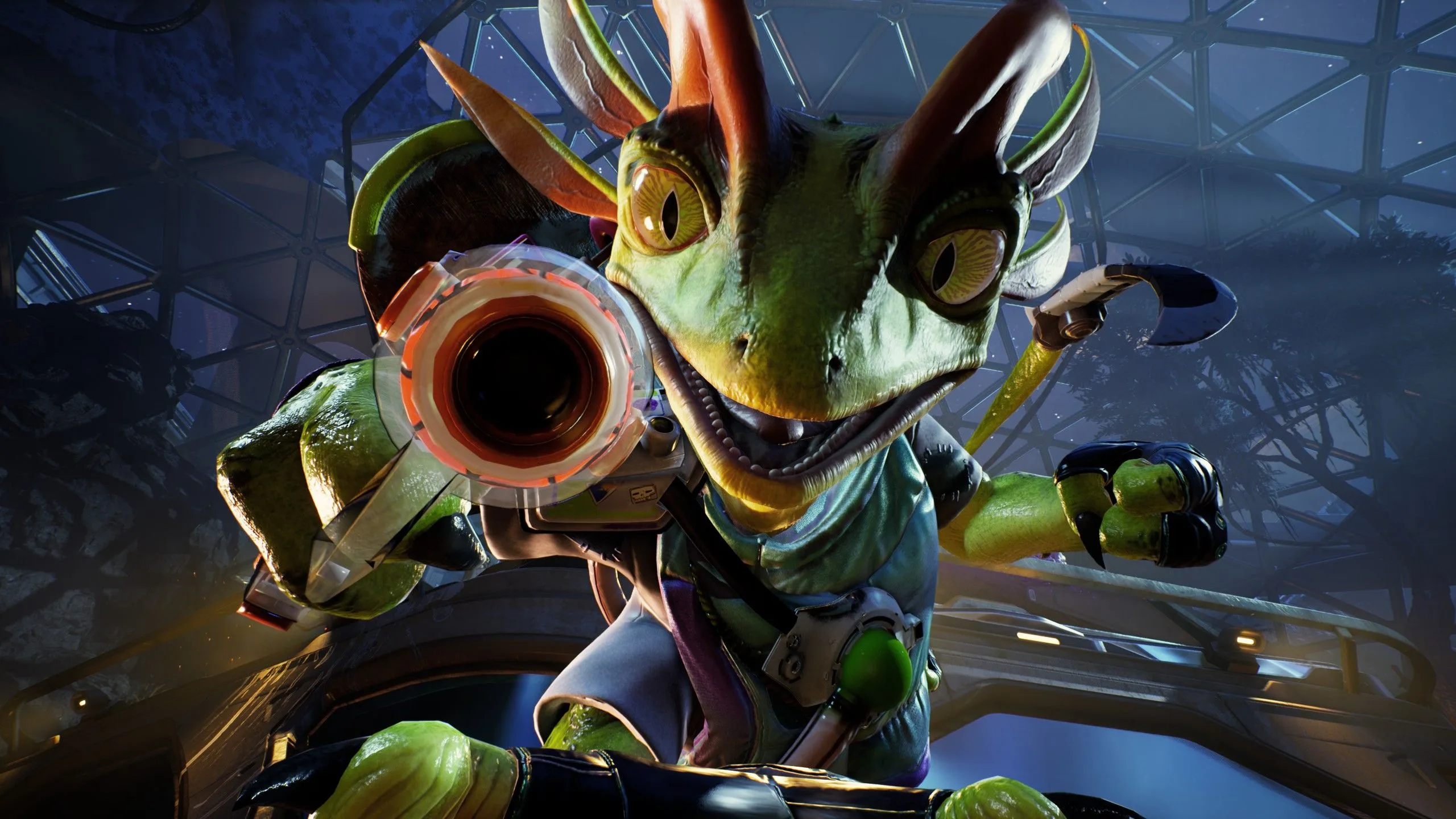
Your arsenal of talking weapons, the Gatlians, has expanded to seven. New additions like Travis (a fast-talking, dual-wield pistol voiced by Ken Marino) join returning favorites like Gus. Each Gatlian has unique abilities used for both combat and environmental puzzle-solving, encouraging weapon swapping in the Metroidvania-inspired world. Exploration is rewarded with Luglox collectibles, which contain currency, cosmetics, and permanent upgrades, creating a solid loop for completionists who can spend 17-25 hours hunting every secret.
This is where reception splits. Some found the core gunplay "tighter and more responsive" than the original. Yet, a more common critique labels combat as "sloppy and overly simplistic." Fights often devolve into chaotic visual soups that are hard to read, with enemy feedback lacking punch. The skateboard, while fun in open spaces, can make controlled engagements feel frustratingly messy.
A Technical Rollercoaster: Performance Across Platforms
High on Life 2 is a visual showcase of Unreal Engine 5's potential—and a stark lesson in its current demands. Utilizing Nanite virtualized geometry and Lumen global illumination, the game's alien vistas and dense cityscapes can look stunning. However, this ambition comes at a heavy cost, particularly on consoles.
On PlayStation 5 and Xbox Series X, the experience is compromised. Analyses reveal the game renders at a surprisingly low internal resolution—often between 720p and 792p—before employing upscaling techniques. It consistently fails to hold its target 60fps, suffering from noticeable framerate dips and instability. The situation is more severe on Xbox Series S, which sacrifices the Lumen lighting system entirely and features reduced shadow and texture quality.
The PC experience is a tale of two rigs. On a high-end system (think an RTX 5090), the game delivers on its next-gen visual promise. For everyone else, it’s a demanding ordeal. Mid-range systems and GPUs with only 8GB of VRAM struggle with poor performance and traversal stuttering. Our review build was also buggy, featuring screen freezes, progress-hindering glitches, and dialogue overlap. The hope for a smooth experience rests heavily on the efficacy of its day-one patch.
Standout Creativity and Character
If the technical execution is uneven, the creative vision is brilliantly consistent. High on Life 2 earns universal praise for its wild, inventive scenarios that constantly break up the core gameplay. One moment you’re solving a murder mystery on a luxury cruise ship, the next you’re facing a boss that invades the game’s own UI. These one-off set pieces are the game’s highlight, showcasing a confidence and creativity that few other titles match.
The voice cast steps up to fill any perceived void, delivering standout performances. Ken Marino’s Travis is a motor-mouthed delight, Ralph Ineson brings gravelly gravitas to the sword Gatlian Sheath, and Richard Kind is perfectly unhinged as Senator Muppy Doo. It’s worth noting an audio mixing issue at default settings can sometimes obscure this excellent dialogue, suggesting players may need to tweak sliders to hear the jokes they came for.
High on Life 2 is a game of stark, almost frustrating contrasts. It is narratively ambitious, brilliantly creative, and often laugh-out-loud funny, confidently establishing Squanch Games' identity beyond its past. Yet, it is equally held back by significant technical shortcomings on consoles and PC, alongside combat that remains divisive and messy. It will undoubtedly satisfy fans craving more of this uniquely bizarre universe and humor. However, its $60 value proposition hinges entirely on a player's tolerance for performance flaws and the success of post-launch support. This chaotic sequel lands its most ambitious tricks, but whether you stick the landing with it depends entirely on your patience for its messy performance.
Tags: High on Life 2, Squanch Games, FPS, Game Review, Unreal Engine 5